Little-Known Mistakes and Bloopers in The Dukes of Hazzard
Few television shows from the late 1970s and 1980s are as instantly recognizable as The Dukes of Hazzard. With its unforgettable characters, fast cars, country humor, and spectacular stunts, the series became a pop-culture phenomenon. At the center of it all was the General Lee, the bright orange Dodge Charger that seemed to spend as much time in the air as it did on the roads of Hazzard County.
But while viewers were busy watching Bo and Luke Duke outrun Sheriff Rosco Coltrane, Boss Hogg, and seemingly endless police cars, plenty of small mistakes were quietly slipping past them.
Some were continuity errors. Others were caused by the show’s demanding production schedule, while several resulted from the practical nature of filming action sequences before modern digital effects were available. Today, these little imperfections have become part of the fun for longtime fans.
Here are some of the lesser-known mistakes and bloopers worth watching for when revisiting The Dukes of Hazzard.
The General Lee Wasn’t Always the Same Car
The General Lee may have looked like one indestructible automobile, but production actually required numerous Dodge Chargers.
The reason was simple: the series featured an extraordinary number of jumps, crashes, collisions, and other stunts. Vehicles used for those sequences could be heavily damaged or completely destroyed.
As a result, careful viewers can sometimes spot differences between Chargers used in supposedly continuous scenes.
Body damage may suddenly disappear. Wheels can look different. Trim and bumpers aren’t always identical. Even the condition of the paint can change from one camera angle to another.
For viewers watching on older televisions, these differences were easy to overlook. Modern high-definition pictures make them considerably easier to spot.
Damage That Magically Disappears
One of the show’s most amusing continuity problems involves vehicle damage.
A car might be involved in a spectacular collision, only to appear surprisingly intact in the next shot. A dented fender can suddenly look perfect, or a damaged bumper may return to its original condition.
This wasn’t necessarily an editing mistake in the traditional sense. Scenes were frequently filmed from different angles and sometimes on different days. The production team would then assemble the footage into a single action sequence.
The priority was creating an exciting chase—not ensuring that every scratch remained perfectly consistent.
The Famous Car Jumps
The General Lee’s spectacular jumps were among the show’s biggest attractions, but they also created some interesting continuity quirks.
The car taking off from a ramp and the vehicle landing after the jump were not always the same automobile.
Different Chargers were prepared for different stages of the stunt. One might be modified specifically for launching, while another was prepared for the landing.
When viewed quickly, the cuts are nearly invisible. Freeze-frame the sequence, however, and differences in bodywork, wheels, or damage can become apparent.
Stunt Drivers Occasionally Give Themselves Away
Although John Schneider and Tom Wopat performed some driving scenes, professional stunt drivers were essential for the show’s most dangerous sequences.
During certain shots, particularly those involving high-speed driving or major jumps, the person behind the wheel isn’t the actor.
Sharp-eyed viewers can sometimes notice differences in appearance between the actor and the stunt performer. Helmets, altered seating positions, or changes in hair can make the substitution easier to recognize.
It’s a small detail, but it becomes surprisingly obvious once you know what to look for.
Sheriff Cars Suffer From Continuity Problems Too
The General Lee gets most of the attention, but the police cars of Hazzard County weren’t immune to mistakes.
Sheriff Rosco’s patrol vehicles regularly changed throughout the series. During a single chase, viewers may notice differences in grille condition, light bars, wheels, mirrors, or body damage.
Again, this was largely the result of practical filmmaking. Police cars were also subjected to demanding stunt work, meaning replacements were inevitable.
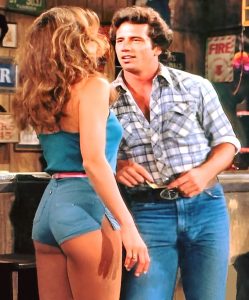
Daisy Duke’s Accessories Change
Catherine Bach’s Daisy Duke became one of the show’s most recognizable characters, and fans often remember her iconic wardrobe.
But even Daisy’s costume occasionally contains continuity errors.
Accessories such as earrings, belts, scarves, and other small details can appear or disappear between shots. Hair positioning may also change noticeably during conversations that supposedly take place within moments of each other.
These inconsistencies were common in television production and rarely distracted audiences from the story.
Objects Move Around the Hazzard County Offices
Continuity mistakes aren’t limited to cars and costumes.
Look closely at office scenes involving Boss Hogg or Sheriff Rosco, and you’ll sometimes notice that objects move between shots.
Papers shift.
Cups appear in different locations.
Telephones and desk accessories aren’t always positioned consistently.
These changes generally happened because scenes required multiple takes. Crew members would reset equipment, actors would move around, and props could be repositioned without anyone realizing the difference would be visible after editing.
Dust Doesn’t Always Match
The show’s dirt roads provided the perfect environment for dramatic chases, but they also created continuity challenges.
A vehicle speeding down a dirt road might create a huge cloud of dust in one shot. The next angle, supposedly filmed moments later, can show considerably less dust.
The opposite can happen too.
The reason is that different camera angles may have been filmed separately, with wind and weather conditions changing between takes.
Shadows Reveal the Crew
Fans who enjoy examining older television shows frame by frame may occasionally discover shadows that don’t belong to the characters.
Camera operators, lighting equipment, and other production elements could cast shadows onto the ground, particularly during outdoor scenes.
Because many sequences were filmed under bright natural sunlight, eliminating every unwanted shadow wasn’t always practical.
The result is a tiny glimpse of the filmmaking process hidden inside the finished episode.
Explosions Don’t Always Match
Action sequences involving explosions can produce some entertaining inconsistencies.
A vehicle may appear heavily damaged from one angle and relatively intact from another. Flames can also change dramatically between shots.
That’s because practical effects were filmed separately and then edited together.
Rather than creating every explosion in a single uninterrupted take, filmmakers captured multiple shots that looked exciting from different angles.
The result worked brilliantly for entertainment, even if the details weren’t always perfectly consistent.
Clothing Gets Surprisingly Clean
Hazzard County isn’t exactly known for being spotless.
The characters spend plenty of time racing down dirt roads, working around cars, crashing through obstacles, and getting involved in various adventures.
Yet their clothing often looks remarkably clean afterward.
A character may be covered in dust in one shot and appear considerably cleaner in the next.
This is another consequence of filming scenes out of sequence. Costume continuity was important, but maintaining perfect levels of dirt and wear was not always practical.
Background Details Can Change
Another category of blooper involves the scenery itself.
Vehicles, signs, equipment, and background objects sometimes move between shots. A truck parked in one location may suddenly be somewhere else, or a background vehicle may disappear entirely.
These details are easy to miss because viewers naturally concentrate on the main characters and action.
However, once you start actively searching for continuity errors, the background becomes almost as entertaining as the story.
Why These Mistakes Happened
It’s important to remember that The Dukes of Hazzard was produced during an era when television production operated very differently from today.
There was no digital editing capable of instantly correcting continuity problems. Computer-generated imagery wasn’t available to repair damaged vehicles or create convincing digital replacements.
Most of the show’s action was accomplished practically.
Real cars jumped.
Real stunt performers drove at high speeds.
Real vehicles were damaged.
Real explosions were filmed.
That approach created an authentic energy that modern productions sometimes struggle to reproduce.
The production also had to work efficiently. With demanding schedules and large numbers of action sequences, perfection in every frame simply wasn’t realistic.
The Mistakes Are Part of the Charm
For modern viewers, these bloopers don’t necessarily make The Dukes of Hazzard less enjoyable. In many ways, they make the show more fascinating.
Every continuity error provides a glimpse behind the curtain.
A different wheel reveals that another car was used.
A suddenly repaired bumper shows how the production assembled a stunt sequence.
A missing prop reminds us that the scene may have been filmed over multiple takes.
Rather than ruining the illusion, these details demonstrate how much work went into creating the series.
A Show Built on Practical Stunt Work
Perhaps the biggest reason fans continue to revisit The Dukes of Hazzard is the sheer ambition of its action sequences.
The series pushed cars, stunt performers, cameras, and production crews to their limits. The General Lee became one of television’s most famous vehicles precisely because viewers could see real cars performing spectacular physical stunts.
Those practical effects came with an unavoidable trade-off: continuity wasn’t always perfect.
But that imperfection is part of the show’s identity.
Decades after the series originally aired, fans can still sit down with an episode and discover something they didn’t notice before. A changing wheel, a mysteriously repaired dent, a misplaced prop, or a stunt driver’s fleeting appearance can turn an ordinary rewatch into a treasure hunt.
And perhaps that’s the most entertaining thing about these mistakes.
They give longtime viewers another reason to return to Hazzard County.
The Dukes of Hazzard may not have been flawless, but it didn’t need to be. Its combination of humor, memorable characters, fast cars, and daring practical stunts created something that audiences continue to remember decades later.
The next time you watch an episode, don’t just follow the chase. Look at the cars, the costumes, the background, and the props.
You might discover that Hazzard County has been hiding a few secrets in plain sight all along.