For months, the Russian high command had staked everything on a single, decisive breakthrough.
The objective was clear: penetrate the heart of Donetsk and shatter the “Fortress Belt,” a 50-kilometer corridor of steel and concrete stretching from Sloviansk to Kostyantynivka and Druzhkivka.
Russian commanders were so confident in their numerical superiority that they predicted a total collapse of the Ukrainian defense.
Instead, the world is now witnessing what military analysts are calling a structural impasse.
The Russian army is not just stalling; it is being ground down at a rate that is statistically unsustainable.
The initial phase of the Russian assault was characterized by a massive expenditure of both manpower and ammunition.
Motorized brigades, including elements of the 3rd Combined Arms Army and the 123rd Separate Motorized Brigades, moved in relentless waves.
They utilized heat-masking ponchos and night-vision equipment to infiltrate Ukrainian trenches under the cover of darkness.
In the tactical sectors of Kostyantynivka, units such as the Chechen Sever-Akhmat and the 136th Separate Motorized Brigade pressed hard against the Ukrainian lines.
The strategy was one of pure attrition: attack in waves, pause, and attack again until the defenders were overwhelmed.
However, on the morning of April 30th, the momentum shifted in a way the Kremlin never anticipated.
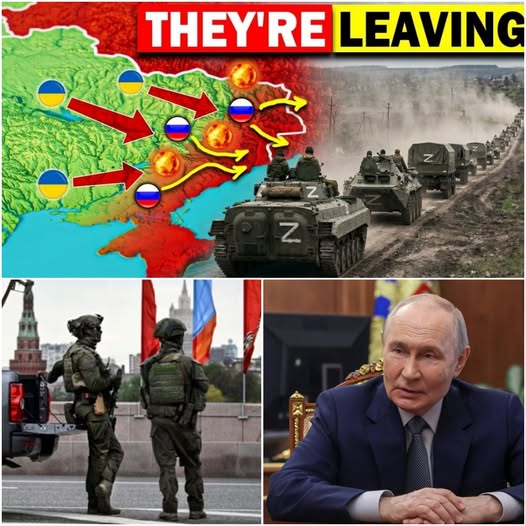
As Russian “mil-bloggers” were prematurely celebrating the capture of eastern Sloviansk, the Ukrainian 11th Army Corps launched a surgical counteroffensive.
Utilizing the low-lying terrain as a natural trap, Ukrainian artillery and FPV drones systematically dismantled the stalled Russian assault waves.
The surprise was total.
Russian soldiers, who had arrived expecting a breakthrough, suddenly found themselves caught in a ring of fire.
Geolocated reports quickly confirmed the reality: the territory Russian sources claimed to control was being liberated by Kiev’s forces at a rapid pace.
The scenes left behind during the Russian retreat were described by observers as “shocking.”
Abandoned positions, wounded soldiers left to fend for themselves, and mountains of discarded equipment painted a picture of a military in the throes of a morale crisis.
This was not a tactical withdrawal; it was a panicked flight.
Some units reportedly fled without looking back, leaving behind the very concrete bunkers they had fought for months to occupy.
The gates of Sloviansk, which Putin had hoped to kick open, have instead been slammed shut.
The failure of the spring offensive is best understood through the lens of cold, hard data.
In April 2026, the Russian army captured 12% less territory than it did in March, despite a significant increase in the frequency of offensive operations.
Russia is attacking more but advancing less.
Deep state data indicates that Russian forces are now required to launch an average of 36 separate assault operations for every single square kilometer gained.
To capture a city like Kostyantynivka at this current pace would require Russia to concentrate its entire frontline force on a single point for weeks—a feat rendered impossible by Ukraine’s drone-led defensive strategy.
While the territorial gains for Russia have dwindled, the human cost has skyrocketed.
Major General Pivnenko, commander of the Ukrainian National Guard, recently noted that a thousand Russian casualties a day has become the “norm.”
NATO data suggests that total Russian losses since the start of the conflict have reached a staggering 1.3 million, with 400,000 of those occurring in 2025 alone.
The weight of these losses is falling disproportionately on Russia’s ethnic republics.
Men from impoverished regions like Bashkortostan and Tatarstan are dying at rates that far exceed the casualties suffered during the entire 10-year Soviet-Afghan war.
This manpower crisis is compounded by a catastrophic failure in equipment and technology.
As Soviet-era stockpiles of T-62 tanks and BMP-1 vehicles run dry, Russian forces have been forced to resort to increasingly desperate measures.
It is now common to see Russian troops attempting to storm Ukrainian positions using motorcycles, ATVs, and even golf carts.
These unarmored vehicles offer no protection against Ukraine’s swarms of FPV drones, leading to “slaughterhouse” conditions on the battlefield.
Furthermore, the Russian military’s dependence on foreign technology has become a fatal flaw.
A pivotal turning point occurred on April 30th, when the Russian government banned the import of foreign satellite communication systems, including Starlink.
While framed as a national security measure, the decision has crippled frontline coordination.
When SpaceX disabled gray-market Starlink terminals used by Russian units, the result was immediate chaos.
Drone video feeds were cut, units lost contact with their commanders, and soldiers were forced to rely on paper maps and GPS-enabled civilian phones.
This communication blackout directly contributed to Ukraine’s ability to recapture hundreds of square kilometers of territory in the Zaporizhzhia and Donetsk regions.
In contrast, Ukraine is moving toward a vision of total “robotization.”
The communication infrastructure behind Ukrainian lines has been reinforced with thousands of kilometers of fiber-optic cable, making their systems immune to Russian electronic warfare.
While Russian soldiers are navigating with outdated paper maps, Ukrainian operators are directing high-precision fire using real-time, high-definition drone imagery.
This technological asymmetry is widening every day, allowing small, specialized Ukrainian units to hold off much larger Russian formations.
The Kremlin’s refusal to order a full-scale mobilization, fearing the social trauma and mass exodus seen in 2022, has left them reliant on high-cost voluntary contracts.
Bonuses for new recruits have reached astronomical levels, draining the national budget while producing soldiers of increasingly lower quality.
With over 57% of new contract soldiers coming from prisons or low-income areas with minimal training, the Russian army is becoming a force of “quantity over quality” in a war where quality and technology now reign supreme.
What the world is witnessing in the “Fortress Belt” is the exhaustion of Russia’s offensive capabilities.
The era of large-scale tank breakthroughs is over, replaced by a war of drones, ground robots, and surgical interventions.
Ukraine has demonstrated that it does not need a massive, conventional counteroffensive to win; it only needs to remain resilient.
By holding the line at Sloviansk and Kostyantynivka, Ukraine has not just won a battle; it has potentially altered the entire course of the war.
Putin’s dream of a conquered Donetsk is tearing at the seams, one failed assault at a time.