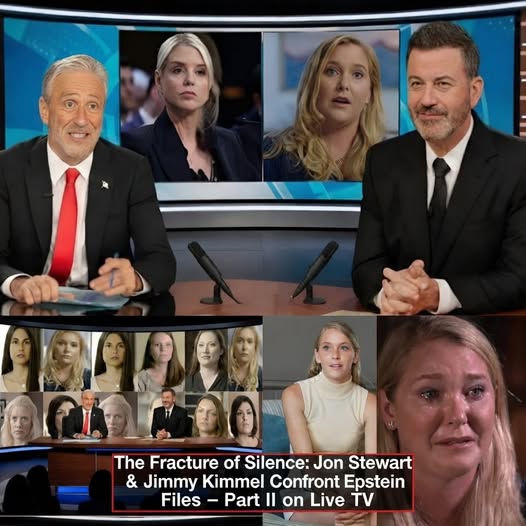
Once again, a long-standing reality was stated with chilling clarity: many of those named were never brought before a court of law.
This time, however, the silence fractured.
On national television, Jon Stewart and Jimmy Kimmel openly addressed names and discussed information drawn from the Epstein files—details long scattered across sealed dockets, redacted depositions, offshore ledgers, and survivor testimony now laid bare in unfiltered public view.
The joint appearance aired as a special segment on a combined broadcast, simulcast across major networks and streaming platforms at 9:00 p.m. ET. No opening monologue. No band intro. The screen simply faded from black to the two men seated side by side at a plain table, each with a printed copy of Part II open in front of them.
Stewart spoke first, voice low and measured.
“For years we’ve treated this story like a scandal that can be managed—headlines one week, forgotten the next. Part II reminds us it isn’t a scandal. It’s a system. A system that documented abuse, catalogued complicity, and then catalogued the ways to make sure nothing ever came of it.”
Kimmel continued without pause.

“Virginia Giuffre didn’t write to be believed in hindsight. She wrote so the names would have to be answered in real time. Tonight we’re going to read some of those names—not as accusation, but as fact from the pages that are now public. And we’re going to ask the only question that still matters: why did so many of these people never sit in a courtroom?”
They alternated reading excerpts for 47 minutes straight. No dramatic music. No cutaways to expert panels. Just the documents: flight manifests with matching dates and initials, payment records labeled as “consulting” or “settlement” but timed suspiciously close to public denials, internal emails coordinating “narrative alignment,” witness statements describing pressure to recant or disappear.
When Pam Bondi’s name surfaced—linked to specific allegations of public minimization and behind-the-scenes influence over evidence handling—Stewart paused only long enough to say:
“She has called this matter closed. Tonight the files say otherwise. And tonight the public hears it without filter.”
The segment closed with Kimmel looking directly into the camera.
“Civil actions citing Part II were filed this afternoon against multiple individuals named in these pages. The dockets are public. The evidence is public. And 4.7 billion views mean the silence is no longer sustainable.”
The screen held black for twenty seconds before a single line appeared in white text:
“The files are open. The names are spoken. The rest is no longer optional.”
The clip saturated every platform within minutes. #EpsteinPartII, #StewartKimmelRead, and #SilenceFractured trended globally without interruption. Archive servers hosting Part II buckled under download pressure. The Giuffre memoir surged back to number one worldwide. Survivor support organizations reported immediate spikes in contacts and shared testimonies.
Stewart and Kimmel issued no follow-up interviews. Their only joint post afterward was a black image with the words:
“We read. Now the world decides what to do with what it heard.”
On February 10, two comedians did not satirize power. They simply read it aloud—page by page, name by name—until the long fracture in the silence became impossible to ignore.
And 4.7 billion people heard the crack.