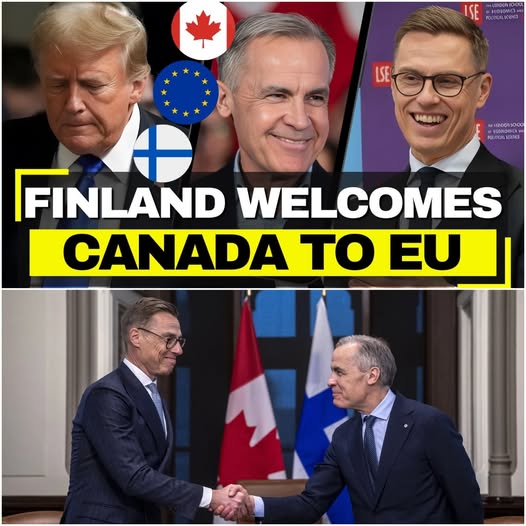
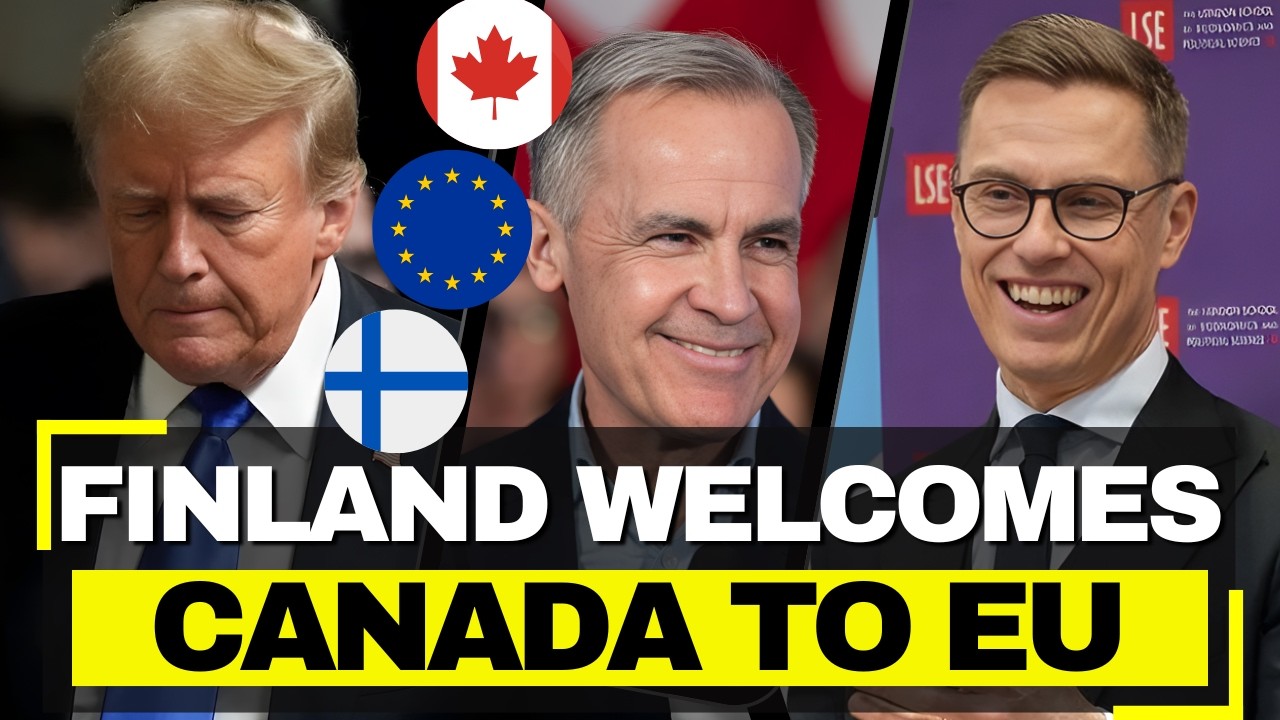
The remark did not come wrapped in ceremony or buried in diplomatic ambiguity. During a visit to Ottawa this week, Alexander Stubb offered a line that, in another era, might have sounded implausible: Canada, he said, could one day become part of the European Union — if it chose to.
It was not a formal proposal. Nor was it a policy blueprint. But in the careful language of statecraft, such statements are rarely accidental. They signal direction, test reactions, and prepare the ground for conversations that once seemed out of reach.

Mr. Stubb’s visit — the first by a Finnish president to Canada in more than a decade — came at a moment of unusual geopolitical fluidity. Only weeks earlier, Canadian Prime Minister Mark Carney had convened leaders from Nordic nations in Oslo, underscoring a growing alignment between Canada and Northern Europe on security, trade and Arctic policy.
In Ottawa, that alignment took on institutional form. Canada and Finland signed agreements on maritime cooperation, including joint development of icebreaker technology, as well as frameworks for intelligence sharing and defense coordination. These were not symbolic gestures. They were technical, specific and designed for long-term integration.
The language accompanying the agreements was equally telling. Both governments spoke of “strategic autonomy” and “values-based realism,” phrases that have increasingly defined European thinking as the global order shifts. In essence, they describe a world in which alliances are diversified, dependencies reduced and traditional frameworks
For Canada, the shift reflects both necessity and opportunity. Long bound economically and militarily to its southern neighbor, Ottawa has in recent years sought to expand its network of partnerships. The existing trade framework with the European Union, Comprehensive Economic and Trade Agreement, already provides a foundation for deeper integration.

What Mr. Stubb articulated goes beyond trade. It gestures toward a reimagining of political geography itself. The European Union, once conceived as a regional bloc, has steadily expanded its scope — first eastward after the Cold War, and now, potentially, outward in less conventional ways.
Such an evolution would not be without precedent in spirit, if not in form. The European project has always been as much about shared norms and institutions as it has been about borders. Canada, with its regulatory alignment, bilingual culture and parliamentary system, fits comfortably within that framework.
Yet the obstacles remain substantial. Membership in the European Union is governed by treaties that assume geographic Europe as their domain. Any inclusion of Canada would require legal revisions, political consensus and a redefinition of what the union represents.
Still, the fact that such questions are now being entertained — however tentatively — speaks to a broader transformation. Europe is recalibrating its role in a world marked by strategic competition and uncertainty. The war in Ukraine, shifting alliances and evolving economic pressures have accelerated this process.
Finland’s own trajectory illustrates the change. Following Russia’s invasion of Ukraine, the country moved swiftly to join NATO, abandoning decades of military nonalignment. Its perspective on security is now firmly anchored in collective defense and regional cooperation — principles it increasingly shares with Canada.
There is also the Arctic dimension. As climate change reshapes northern waterways, both countries find themselves at the forefront of emerging maritime routes and resource considerations. Collaboration in this क्षेत्र is not merely strategic; it is inevitable.
What emerges, then, is less a sudden pivot than a gradual convergence. Multilateral meetings lead to bilateral agreements. Technical cooperation deepens into strategic alignment. And, occasionally, a political leader gives voice to a possibility that crystallizes the trajectory.
Mr. Stubb’s comment may ultimately prove to be just that: a moment of articulation rather than initiation. But in diplomacy, articulation matters. It defines the boundaries of what can be imagined — and, eventually, what can be pursued.
For now, Canada remains outside the European Union, both geographically and institutionally. But the distance, in political and strategic terms, appears to be narrowing.