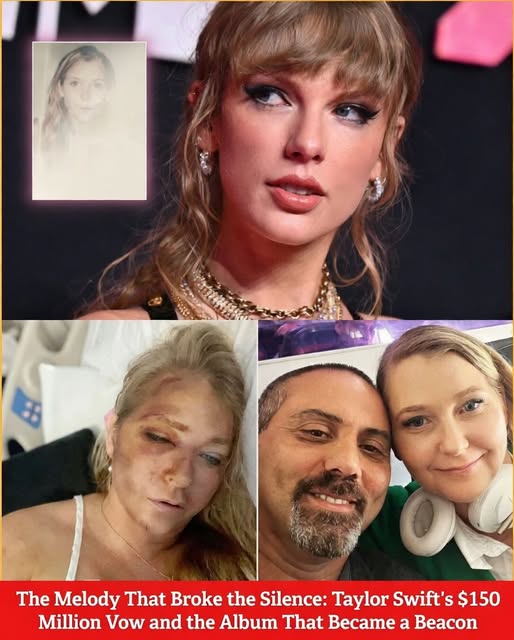
Just a few hours after finishing the final pages of Virginia Giuffre’s haunting memoir, Taylor Swift — known for her discretion and carefulness — stunned all of Hollywood. In a 40-minute livestream, her voice calm yet chilling, she announced that she would release a new album and spend $150 million of her own money to bring the truth to light, for Virginia and for everyone who had ever been forced into silence.
The stream began quietly. No elaborate set, no backup dancers, just Swift seated in soft lighting with the memoir resting on the table beside her. She spoke directly to the camera, no filter, no script visible.
“I finished reading Virginia’s words last night,” she began. “I couldn’t sleep after. Every page felt like a responsibility I didn’t ask for—but one I can’t ignore anymore. She wrote so others wouldn’t have to stay quiet. She paid a price most of us can’t imagine. And the world still tries to minimize it, redact it, forget it. That ends here.”
She paused, then delivered the announcement that sent shockwaves through industry group chats, executive offices, and fan forums alike.
“I’m releasing a new album. It’s called Unredacted. Every song is built around truth—survivor stories, suppressed documents, the mechanics of silence. Some tracks will use direct excerpts from public records. Others will carry the weight of what’s still hidden. And I’m putting $150 million of my own money behind this—not just for production, but for real action: funding independent investigations, legal teams for survivors, secure channels for new evidence, and a documentary series that runs parallel to the music. This isn’t merch. This isn’t a tour tie-in. This is accountability.”
The number—$150 million—was staggering even by Swift’s standards. She explained it plainly: $50 million for the album’s creation and global distribution without label interference, $50 million to support ongoing civil litigation tied to Epstein-related cases, and $50 million for a perpetual fund that would reward verifiable new information with life-changing grants to whistleblowers and victims.
“I know what people will say,” she continued. “That I’m chasing headlines. That I’m out of my lane. That celebrities should stick to entertainment. But music has always been political when it had to be. It’s been protest. It’s been witness. If I can use my voice—and yes, my platform and my resources—to make sure one more person doesn’t feel alone in the dark, then that’s the only lane that matters right now.”
The livestream chat exploded in real time: hearts, flames, crying emojis, calls for justice, and waves of skepticism. By the end of the 40 minutes, #Unredacted and #TaylorForTruth were global number one trends. The memoir surged back to the top of bestseller lists. Advocacy groups reported an immediate influx of messages from people ready to speak.
Hollywood’s response was fractured. Some stars quietly liked the original post. Others issued vague statements about “complex issues.” A handful of powerful figures reportedly convened urgent meetings. Meanwhile, Swift’s team confirmed the album was already in final mixing, with no traditional label attached—distributed independently through her own channels.
In the days that followed, snippets leaked: haunting piano lines layered with courtroom audio, lyrics that named mechanisms of power rather than individuals, bridges built from survivor testimony. Critics called it her most daring work yet; supporters called it her most necessary.
Whether Unredacted becomes a cultural earthquake or faces legal and cultural headwinds, Taylor Swift had done something few expected from a pop icon: she turned empathy into infrastructure. She made silence expensive. And she reminded the world that sometimes the loudest weapon isn’t a shout—it’s a song that refuses to fade.
For Virginia. For the silenced. For anyone still waiting for the light.