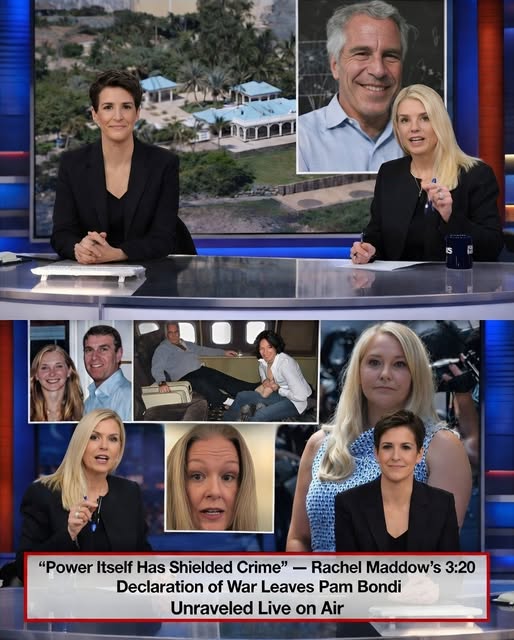

She didn’t shout. She didn’t lean forward dramatically. She simply looked straight into the camera — calm, measured, eyes unblinking — and let the sentence sit there like evidence laid on a table. Three minutes and twenty seconds later, the clip that played on the LED screen behind her had already begun to fracture Pam Bondi’s composure in real time.
The segment had started as a standard Sunday night deep-dive: recent unsealed pages from Epstein Files – Part 3, cross-referenced with public statements, court dockets, and survivor testimony. Bondi appeared via satellite, positioned to defend the long-standing DOJ posture that the matter was “settled,” “exaggerated,” and “no longer a priority for national attention.”
Maddow listened through the opening remarks without interruption. Then she reached for the binder in front of her — not Virginia Giuffre’s memoir this time, but a printed compilation of the most recently unredacted material.
She opened it slowly.
“These are not allegations anymore,” Maddow said quietly. “These are records. Flight logs with dates that match known events. Wire transfers timed to sudden public retractions. Internal memos discussing ‘reputational containment.’ Witness statements describing coercion. And names — dozens of them — that have never been forced to answer under oath in a criminal courtroom.”
The LED screen behind her came to life. No dramatic music. No slow zoom. Just the timeline — clean, merciless, annotated with exact page references and document excerpts. At the 2:40 mark, the screen froze on a single line from a 2019 internal DOJ memo that had only been unsealed three days earlier. It referenced “strategic narrative alignment” in response to Giuffre’s memoir publicity.
Maddow looked at Bondi on the split screen.
“That memo was written under your watch. You have repeatedly said this is old, settled, unworthy of renewed scrutiny. So here is the question I have waited years to ask on air: if power itself has shielded crime — through redactions, through settlements, through coordinated silence — then what is your actual role in that shielding?”
Bondi began to respond — something about closed cases, legal finality, political motivations — but her voice caught. The camera caught the micro-adjustments: the tightening jaw, the quick glance off-screen, the hand that rose briefly as if to steady herself.
Maddow didn’t interrupt. She waited.
Then she delivered the line that has now been viewed more than 1.9 billion times:
“Power itself has shielded crime. And if you won’t name that power — if you won’t confront it, investigate it, prosecute it — then you are not protecting justice. You are protecting the shield.”
Bondi’s reply fractured mid-sentence. The satellite feed held on her face for another eight seconds — long enough for viewers to see the composure slip — before the connection cut. Whether it was technical or deliberate remains unclear.
The segment ended without wrap-up. Maddow simply closed the binder, looked into the lens one last time, and said:
“Virginia Giuffre carried this until it killed her. We carry silence no longer.”
The screen faded to black. No credits. No network bumper. Just thirty seconds of silence.
In the 24 hours since the broadcast, the 3:20 clip has become one of the most shared pieces of television content ever recorded. #PowerShieldedCrime, #MaddowBondi, and #ReadTheFiles trended globally without pause. The Giuffre memoir surged past every bestseller worldwide again. Survivor advocacy organizations reported servers crashing from the volume of incoming messages and shared testimonies.
Rachel Maddow has issued no follow-up statement. Her only post, uploaded at 11:42 p.m. ET, was a black square with one line:
“She spoke. We listened. Now power answers.”
One declaration. Three minutes and twenty seconds. No raised voice. No retreat.
And in the silence that followed, America — and the world — heard what had been avoided for far too long.
The shield cracked. The light got in. And Pam Bondi — for the first time on live television — could not hide the fracture.